Why the workforce development ecosystem isn’t producing the outcomes the country needs — and how today’s model of employer engagement is part of the problem.
01 — Goals
What a well-functioning workforce development ecosystem delivers
The goal of public investment in education and workforce development is straightforward: learners should be able to reach good jobs, and employers should be able to find the talent they need. These outcomes are two sides of the same coin.
Learners reach good jobs
People who complete education and training programs move into jobs that exist, earn family-sustaining wages, and build careers with room to grow. The investment learners make in their education connects to real economic opportunity.
Employers have the workforce they need
Businesses can hire the workers they need to fill open roles, sustain operations, and grow — directly from public education and training programs. A skilled, well-matched workforce enables employers to thrive and contribute to healthy regional economies.
But across the country, those outcomes are not being achieved — at meaningful scale, and with serious consequences for both sides of the system.
1 in 4
Institutions whose students earn less than a high school graduate
At one in four U.S. higher education and training institutions, most students earn less a decade after enrolling than the $32,000 median for high school graduates – more than 1,000 institutions in all.
Projected gap in postsecondary-educated workers, 2024–2032
18.4 million experienced workers with postsecondary education will retire. Only 13.8 million younger workers with equivalent qualifications will enter the labor market.
Unique credentials on offer across the United States
Degrees, certificates, certifications, licenses, and badges from nearly 135,000 providers – a marketplace learners and employers cannot navigate without a clear signal of which credentials carry value in hiring.
Too many learners graduate underemployed, and too many essential sectors can't find the workers they need. These aren't separate problems. They are two sides of the same systemic failure — a workforce development ecosystem that cannot translate learner willingness to train and employer willingness to hire into the skilled workforce the country needs.
02 — Diagnosis
Employers are the missing link
Workforce development systems fail to deliver when programs don't train people for what employers actually need. And that gap exists because the people best positioned to close it — employers themselves — are not meaningfully part of the decisions that shape the education and training programs that get built.
Employers know things the system cannot know on its own. They are the only actors in the system with direct, current knowledge of how the labor market is changing on the ground. And they hold something no other actor can supply: the workplace itself — the setting where on-the-job training, apprenticeship, and work-based learning happen.
Which jobs they're hiring for now and next
Employers see hiring needs in real time, including emerging occupations and shifts that haven't yet appeared in published labor market data.
Which skills the jobs actually require
Employers know the competencies and technical skills that matter for entry-level roles and career progression in their sector — and how those expectations are evolving.
Which credentials carry real value
Employers see which credentials they actually use in hiring and which they consider proxies of limited value — distinguishing signal from noise in a crowded credential marketplace.
How to actually train people for the work
Employers know what real on-the-job learning looks like, how workers progress through their first months and years, and which training models prepare people to succeed.
None of this knowledge consistently reaches the people designing public training systems. Programs get built around what institutions can already run, what fills classroom seats, and what last year's labor data showed — not a current, ground-truth read of what employers actually need.
This isn't because the system isn't trying to listen. It is — through tens of thousands of advisory committees, surveys, and signature requests every year. The problem is that what employers share in those settings rarely changes what programs actually train people for.
03 — Today's reality
Why employers aren't a meaningful part of the system today
Many would argue employers are a meaningful part of workforce development systems — they sit on tens of thousands of local advisory committees across the country, providing the sign-off required for funding compliance. They're asked at a similar scale to participate in thousands of disparate workforce programs and efforts. The result is a model of employer engagement that is compliance-oriented and focused on filling "slots" — one that does not produce a system where employers truly shape what gets designed and built.
A system can only produce the talent employers need — and the jobs learners need — when employers have a true seat at the table, with real recommendation and decision-making authority. Today, employer engagement across the U.S. largely lives at the lowest, least consequential level on the spectrum of possible employer roles. The framework below describes that spectrum, from the lowest level of authority to the highest. The further right on the spectrum, the more directly employer voice translates into actual change in what the system funds, approves, and builds.
The spectrum of possible employer roles in the workforce development ecosystem
01
Participate
"We sign off and show up."
Employers validate programs through required compliance and sign-off processes, and participate in programs the system has already designed.
Examples
Serving on CTE and community college program advisory boards
Serving on local workforce boards under WIOA
Hosting work-based learning for school- or nonprofit-built programs
This is the dominant U.S. model. Employers validate and participate only after decisions are made — engagement stays fragmented and often ends in disengagement.
02
Advise
"We give strategic input when asked."
The system brings strategic questions to employers; employers provide expert input that informs the system's decisions.
Examples
Advising on sector-wide implications of strategic priorities (e.g., Workforce Pell)
Advising on how to implement system priorities (e.g., expanding work-based learning)
Engagement is strategic, not compliance-oriented — but employers respond to questions the system shapes; they don't set the agenda themselves.
03
Recommend
"Our input is formalized."
Employer bodies are charged with making structured, official recommendations that states must consider.
Examples
Recommending priorities for program and pathway development
Recommending policy or regulatory changes that affect workforce pathways
Recommending training plans for the on-the-job components of programs
Employer input has weight and is embedded into decision-making processes — but the state retains final authority.
04
Decide
"We hold defined authority."
Sector-aligned employer bodies have formal decision-making power over specific system elements.
Examples
Determining which occupations are in demand
Defining the skills and competencies those jobs require
Identifying which credentials carry genuine labor market value
Deciding where training takes place (e.g., on the job or in a classroom)
This mirrors high-performing global systems. Authority is collective, transparent, and accountable.
Today's reality
Most employer engagement within U.S. workforce development ecosystems falls within the Participate model — the lowest level on the spectrum. It happens through compliance and sign-off committees that produce no strategic input and carry no meaningful influence over what the system funds, approves, or builds.
What "compliance-oriented" looks like at scale
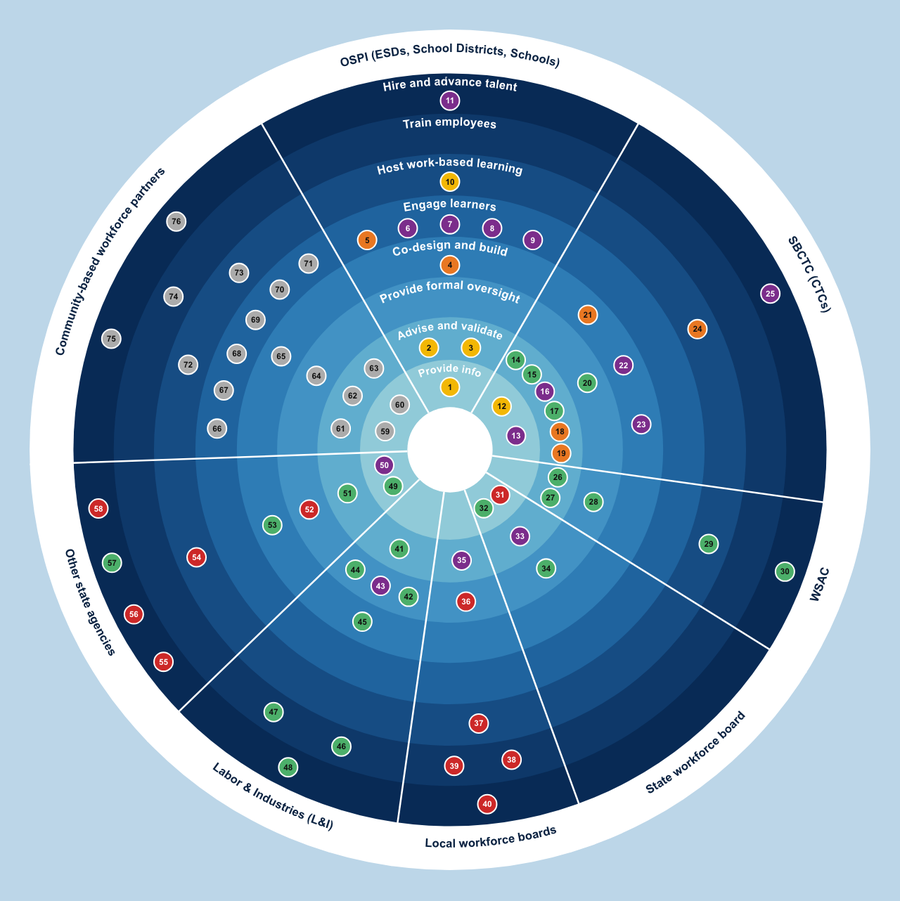
A landscape analysis conducted in Washington state by Partnership for Learning illustrates the scale of the engagement system that has emerged from layered federal and state requirements: in Washington alone, an estimated 2,900 standing employer advisory committees generate roughly 9,000 meetings per year across more than 300 public institutions — most of which exist primarily to satisfy reporting requirements. The touchpoint map below documents more than 75 distinct types of requests Washington's public workforce system makes of employers. Hover any dot to see what it is, or open the full landscape analysis using the link below.
What today's compliance-driven employer engagement produces
When employer voice doesn't carry the authority to shape what the system funds, approves, and builds, the same three outcomes follow — and they compound over time.
Programs train for the wrong things
Programs are built around what institutions can already offer — not around where employers are actually hiring.
Curricula lag behind industry change by years — especially as AI and automation reshape skill demands.
Credentials proliferate without clarity — about which ones carry genuine labor market value.
Public dollars get directed to occupations that aren't in demand — or no longer are.
Learners and employers both bear the cost
Learners graduate underemployed — accumulating debt without proportionate economic payoff.
Essential sectors face chronic, widening shortages — nursing, teaching, skilled trades, and more.
Time-to-fill stretches and positions sit open — capping employer growth and overloading the workers who have to cover the gap.
Public investment produces declining returns — for learners, employers, and taxpayers alike.
Trust in public institutions erodes
Employers build their own training and credentialing solutions — outside the public system, to get the workforce they need.
Public programs get less work-based learning — employers rarely host or hire for programs they had no role in designing.
Communities lose access to essential services — workforce shortages limit who can deliver healthcare, education, housing, and public goods.
Confidence in the public sector's ability to deliver fades — even as reliance on it grows.
Employers find their own workarounds — outside the public system
When the public system can't be a reliable partner, employers organize the engagement they need on their own. Two of the country's most established employer-led models prove the point — but only at the scale of the institutions willing to partner directly with each one.
Talent Pipeline Management is the U.S. Chamber of Commerce Foundation's methodology for organizing employers into industry-led collaboratives that articulate workforce demand and manage talent supply chains. Since launching in 2014, TPM has trained roughly 90 employer-led collaboratives across the country to engage education providers as suppliers and build shared talent pipelines. The model produces real results — but its impact lives in individual partnerships with specific colleges and providers, with no built-in mechanisms offered by public systems to partner on what employer coalitions prioritize or how they deliver value to learners and employers.
FAME USA — the Federation for Advanced Manufacturing Education — is a manufacturer-governed network that trains Advanced Manufacturing Technicians through a two-year work-study program at community colleges. Launched by Toyota in Kentucky in 2010 and now housed within the Manufacturing Institute, FAME operates 45 employer-led chapters across 17 states, each one a partnership between local manufacturers and a specific community college. The model proves employer leadership delivers — but engagement happens institution by institution, because the broader public system remains too complicated and bureaucratic to partner with at scale.
Working around the system gets a small portion of the nation's employers what they need; it cannot change what the system does at scale. The billions in public training dollars — and the vast majority of students those dollars reach — stay inside the system employers have chosen to avoid, still spent against the wrong signal.