The tools below are practical resources for states and leaders considering what an industry-led talent system might look like in their own context – from selecting and strengthening sector intermediaries, to seeing what a demand picture contains, to learning from the places already doing pieces of this work.
Start here
From employers coming together to unlock change, to employers shaping the skills that get taught, to states building employer voice into the system itself. Each case shows where it happened, which sector, and what changed.
Guides and working examples for putting an industry-led talent system in place – who speaks for a sector, what that voice publishes, what the state changes, and how to fund it.
Four designation paths, sample selection criteria, and what to do when a sector has too many candidates – or none.
Open →How an existing employer-led organization can become an effective sector intermediary – the five conditions that let it speak credibly on behalf of its sector, and the practices strong intermediaries use to meet them.
Open →An illustrative example for one state’s aerospace sector – the occupations, skills, credentials, and strategies an intermediary would publish each year.
Open →Which public systems an employer coalition should engage for a given hiring challenge – and what to ask of each.
Open →Three areas of sector intermediary work a state can fund, and the funding sources that can pay for each.
Open →How states can adapt public education, training, and workforce systems to more effectively act on a unified employer voice – why each change matters, what it looks like in practice, and when to pursue it.
Open →
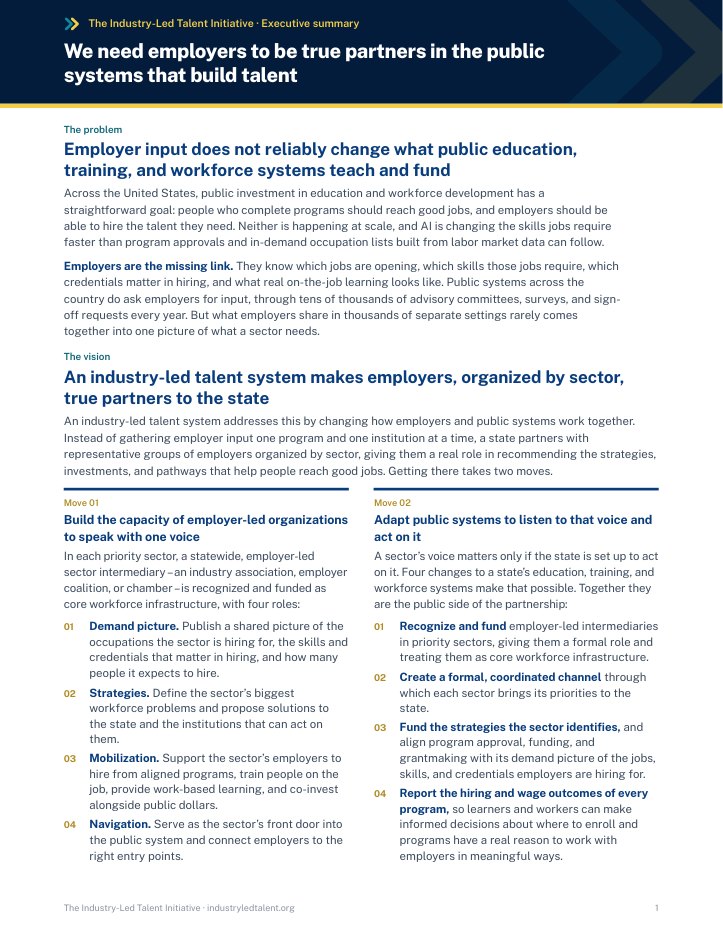
View the two-page executive summary: Why today’s model of employer engagement falls short, the elements of an industry-led talent system, and what sets this approach apart.